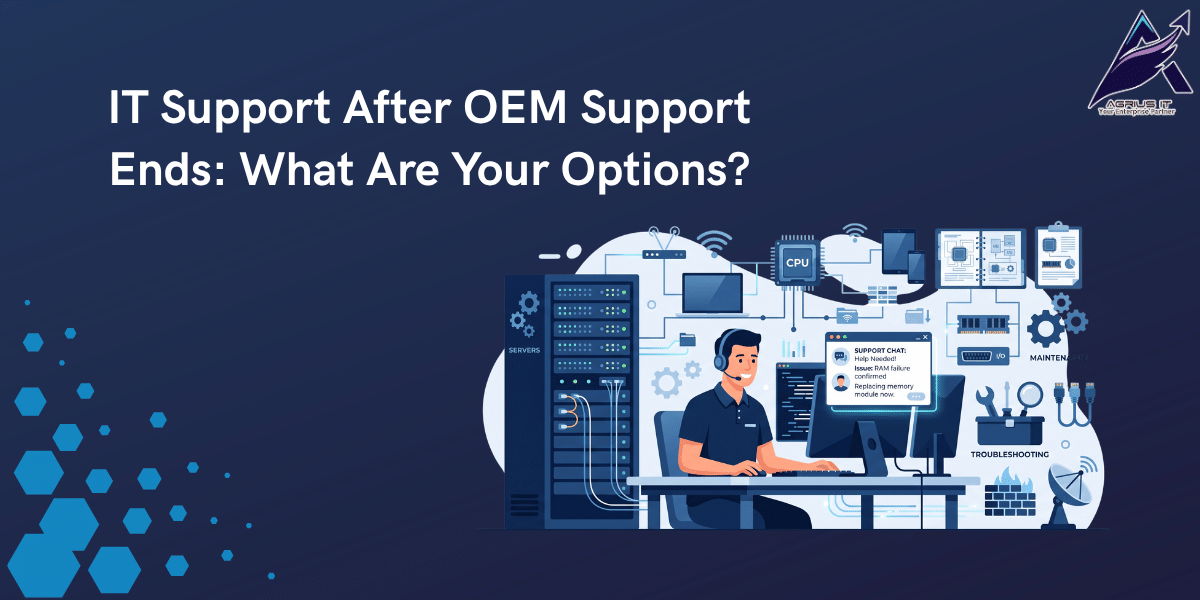
What happens when your servers,storage solutions,or network equipment and tape libraries reach the end of OEM support? Businesses may still have reliable IT equipment that meets their operational needs, but the original equipment manufacturer (OEM) may no longer provide maintenance or technical support. IT support can help businesses continue using existing infrastructure while managing maintenance requirements after OEM support ends.
Instead of replacing working equipment immediately, businesses can consider third-party maintenance, extended support options, refurbished hardware, or equipment replacement based on their technical and business requirements.
What Does OEM Support Ending Mean for Your IT Equipment?
OEM support ending means that the manufacturer has stopped, or is preparing to stop, providing standard technical support for a particular product. This is often referred to as End of Life (EOL) or End of Service Life (EOSL).
After this point, businesses may face limited access to manufacturer support, spare parts, software updates, or other maintenance services. However, reaching EOL does not necessarily mean that the equipment has stopped working.
Many servers, storage systems, switches, routers, tape libraries and other infrastructure components can continue operating for years when they are properly maintained.
Can You Keep Using Equipment After OEM Support Ends?
Yes, businesses can continue using equipment after OEM support ends, depending on its condition, workload, compatibility, and business requirements.
Replacing an entire IT environment simply because the manufacturer has ended support can require significant investment. Businesses may instead assess the condition of their equipment and determine whether continued maintenance is practical.
Professional IT Support can help with monitoring, troubleshooting, hardware maintenance, replacement parts, and other technical requirements for existing infrastructure.
What Is Third-Party Maintenance After OEM Support Ends?
Third-party maintenance (TPM) provides support for IT equipment outside the original manufacturer’s maintenance program.
A TPM provider can support equipment from multiple manufacturers and may provide services for servers, storage systems, network equipment, and tape libraries. Support can include troubleshooting, hardware replacement, on-site assistance, and maintenance based on an agreed service-level agreement (SLA).
For businesses with mixed IT environments, third-party maintenance can provide one support arrangement for equipment from different manufacturers.
How Can IT Support Help With End-of-Life Servers?
Servers often remain important to business applications even after OEM support has ended. Replacing them immediately may not always be necessary.
IT Services for end-of-life servers can include hardware troubleshooting, component replacement, system checks, and on-site technical assistance. Businesses can continue using their existing server infrastructure while planning future upgrades according to their operational requirements.
This approach can also give IT teams more time to plan a controlled migration instead of replacing equipment under time pressure.
What About Storage Equipment After OEM Support Ends?
Storage systems contain important business data, making reliable maintenance an important consideration. Businesses may continue using storage equipment after OEM support ends if the hardware remains suitable for their environment.
Third-party IT Support can cover storage systems such as NAS and SAN equipment. Services may include hardware maintenance, troubleshooting, component replacement, and technical assistance according to the agreed SLA.
Businesses should regularly assess storage capacity, hardware condition, performance, and compatibility before deciding whether to continue using older equipment.
Can Network Equipment Receive Support After EOL?
Yes, Network equipment such as routers, switches, access points, and core switches can also receive third-party maintenance after OEM support ends.
Network downtime can affect communication between users, applications, servers, and other systems. A suitable maintenance plan can provide access to technical assistance and replacement hardware when required.
Third-party network maintenance can be particularly useful for businesses operating equipment from several manufacturers.
Should You Replace or Maintain End-of-Life IT Equipment?
The answer depends on the condition and role of the equipment.
Businesses should consider factors such as:
- Current equipment condition
- Business workload
- Performance requirements
- Availability of replacement parts
- Maintenance costs
- Compatibility with existing systems
- Future technology plans
- Required support response times
If the equipment continues to meet business requirements, maintenance may be considered. If the equipment has become unreliable, incompatible, or too costly to maintain, replacement may be more appropriate.
How Can Businesses Plan IT Support After OEM Support Ends?
A practical approach starts with an inventory of existing IT equipment. Businesses can identify which servers, storage systems, network devices, and other hardware have reached EOL or EOSL.
The next step is to review the condition and importance of each device. Critical equipment may require a defined SLA, spare parts availability, and on-site support.
Businesses can then compare maintenance and replacement costs and create a timeline for future upgrades. This helps IT teams make decisions based on actual infrastructure requirements rather than relying only on the OEM support status.
How Does Agrius IT Provide IT Support After OEM Support Ends?
Agrius IT provides IT Support and Third-Party Maintenance (TPM) services for servers, storage systems, networking equipment, and other IT infrastructure. Its services are designed to help businesses maintain existing equipment after OEM support ends.
Agrius IT supports multiple leading IT brands and provides technical assistance based on business requirements. Services can include hardware maintenance, troubleshooting, spare parts, and on-site support under agreed SLAs.
Businesses can assess their existing infrastructure and discuss available maintenance options before deciding whether to continue using or replace end-of-life equipment.
What Is the Next Step for Your IT Infrastructure?
OEM support ending does not automatically mean that your IT equipment must be replaced immediately. Businesses can evaluate their infrastructure and consider IT Support, third-party maintenance, or replacement based on equipment condition, business needs, and future plans.
If you need support for servers, storage, network equipment, or other IT infrastructure after OEM support ends, contact Agrius IT to discuss your maintenance requirements and available support options.